Understanding Business Cooperatives: A Comprehensive Guide with Iconic Visuals
Introduction to Business Cooperatives
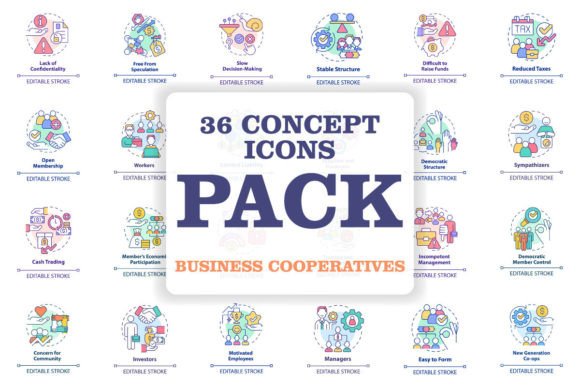
Welcome to our detailed guide on business cooperatives, a unique and impactful model of business organization. This article will explore the concept, its significance, and practical applications, enhanced by a set of 36 editable stroke concept icons designed to visually represent key ideas in the cooperative work environment.
What Are Business Cooperatives?
A business cooperative is an autonomous association of people who voluntarily come together to meet their common economic, social, and cultural needs and aspirations through a jointly owned and democratically controlled enterprise. The core principles of cooperatives include voluntary membership, democratic control, member economic participation, autonomy, education, training, and concern for the community.
Key Principles of Business Cooperatives
- Voluntary Membership: Open to all who can use the services and willing to accept the responsibilities of membership.
- Democratic Member Control: Members contribute equitably to, and democratically control, the capital of their cooperative.
- Member Economic Participation: Surpluses are allocated for developing the cooperative, benefiting members, or supporting other activities approved by the membership.
The Significance of Business Cooperatives
Business cooperatives play a crucial role in fostering a more equitable and sustainable economy. They empower individuals and communities by providing them with a platform to collectively own and manage resources, thus reducing dependency on external entities and promoting local economic development.
Practical Applications in Modern Life
Cooperatives are not just theoretical; they have practical relevance in various sectors:
- Agriculture: Farmer-owned cooperatives help in pooling resources, sharing risks, and improving market access.
- Retail: Consumer cooperatives allow members to buy goods at lower prices and share in the profits.
- Housing: Housing cooperatives provide affordable and stable housing options for members.
- Finance: Credit unions and other financial cooperatives offer competitive financial services to their members.
Visualizing Cooperative Concepts with Icons
To better understand and communicate these concepts, we have created a set of 36 editable stroke concept icons. These icons are designed to be versatile and easy to use, making them perfect for various applications such as brochures, infographics, mobile app screens, and more.
Features of the Icon Set
- Editable Stroke: Customize the icons to fit your specific needs and branding.
- Isolated Symbols: Each icon is provided in isolated form, making it easy to use in any design context.
- Font Compatibility: The icons are compatible with popular fonts like Roboto-Medium and Myriad Pro-Bold, enhancing their versatility.
- Product File Formats: Available in EPS, JPEG, AI (on white background), SVG, and PNG (on transparent background).
How to Use the Icon Set
These icons can be used in a variety of ways to enhance your projects and communications:
- Brochures and Infographics: Illustrate key points and make your content more engaging and visually appealing.
- Mobile App Screens: Use the icons to create intuitive and user-friendly interfaces.
- Educational Materials: Simplify complex concepts and make learning more accessible and enjoyable.
Stay Updated with BSD Studio
For more high-quality design resources and updates, subscribe to BSD Studio. We regularly introduce new topics and offer discounts, ensuring you always have access to the latest and most relevant design tools.
Conclusion
Business cooperatives are a powerful and inclusive way to organize and manage businesses. By understanding and utilizing the principles and visual tools discussed in this article, you can effectively promote and participate in cooperative models that benefit both individuals and communities. Whether you're a beginner or an experienced professional, the insights and resources provided here will help you build a broader and deeper understanding of the cooperative movement.